
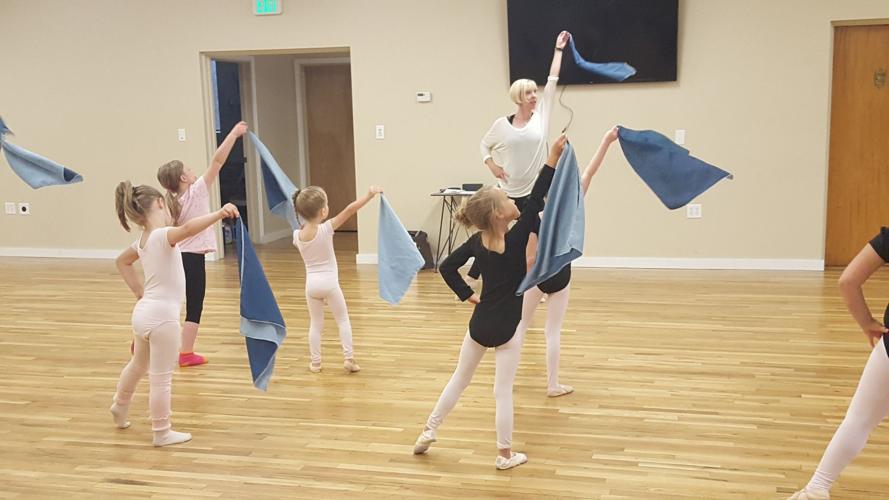


POCATELLO — Anyone can give a class, but not anyone can teach a class, according to dance and fitness instructor Tiffin Bennett, who is building a notable presence in Southern Idaho for her teaching ability — an ability that has remarkably been refined by a son with Down Syndrome.
For 10 years, until 2015, Bennett taught for established Pocatello dance studios. Then, to make life work with her family and to stay true to the teaching fundamentals and positive environment in which she believes, she started her own dance and fitness studio called Miss Tiffin Ballet and Barre.
Bennett now balances a busy teaching schedule at her studio in Pocatello, at the Blackfoot School of Ballet and Theatrical Arts, and at Infinity Dance Studio in Idaho Falls.
She has helped choreograph numbers for Century High School, the Leavitt Center and the Palace Playhouse. And she’s volunteered for the past three years teaching Dance Appreciation and Musical Theater at the Pocatello Community Charter School.
Bennett’s selection of classes are not just for children either. She is certified to teach barre fitness classes. These use ballet exercises along with Pilates and yoga to strengthen, tone, and improve balance. In April she was featured as a top instructor by the International Ballet Barre Fitness Association.
Bennett said that the professional ballet world is highly competitive and sometimes the correct training of young students is neglected and they are pushed too hard, too fast.
Bennett decided to focus her classes on training the younger ballet students with correct technique. Then, if they wanted to advance to more competitive schools, they could do so with less risk of injury.
“Ballet is very particular,” Bennett said. “If you are doing technique incorrectly, injuries can set in at a very young age. A 180-degree turn out is not what our bodies are built to do. ... Oftentimes, in competition schools, you will have the older students teaching the little ones. The older ones, themselves, have not been taught the correct positions, which perpetuates a negative cycle and then it gets locked into the muscle memory.”
Bennett continued, “With little kids, so much more learning is happening in there than technique.”
These include musicality, body work, gross motor skills, fine motor skills, alignment, posture, etiquette, how to stand in line, how to be still, how to focus and how to memorize something like dance steps by recognizing patterns.
“Some people pick these skills up naturally; others need more help,” she said.
Bennett began dancing at 4 when her family lived in Logan. Her father, Ray Butcher, was the offensive coordinator for Utah State University’s football team. While in Logan, her parents took her to see USU’s Festival of the American West, where she fell in love with the folk-type ballet dancing she witnessed.
Bennett attended Southern Utah State College on a gymnastics scholarship. She was ranked 26th in the nation in the NAIA division on the floor exercise, which Bennett describes as dancing with gymnastics.
While attending SUSC, Bennett joined the Burch Mann’s American Folk Ballet Company in Cedar City.
“Imagine my surprise,” Bennett said, “when I realized I was dancing for the very same company I had seen dancing at the Festival of the American West all those years ago. It was quite a moment.”
Bennett majored in dance education and completed her bachelor’s degree in 1991. Bennett danced with the Burch Mann company for eight years, touring Russia and California. And she performed in USU’s Festival of the American West, which Burch Mann had helped write.
Bennett met her husband, Geoffrey, at SUSC when he picked her to be his dance tutor for the Tango.
They married in 1995 and moved to Boise where she taught for Ballet Idaho and the Eagle Performing Arts Center.
In August 2005, the Bennetts decided to move to Pocatello with their sons, Gates and Harper, so that Geoffrey could go back to school at Idaho State University. Tiffin found out she was pregnant with Keaton the same week Geoffrey graduated with his bachelor’s degree from ISU. Keaton was born in January 2009 with Down Syndrome.
“It was a shock and really scary and put me on a learning curve that was completely unexpected,” Bennett said. “Until you are living it, there’s no way to describe raising a child with Down Syndrome. It’s every day. It’s double locks on the door and double gates in his room. It’s constantly watching for choking and making sure he hasn’t wandered off or bolted for something. He has no sense of danger. It’s a constant hum and worry.”
Bennett said every developmental milestone became a celebration. She and a friend worked for nine months to help Keaton learn to walk.
“I would hold him up and she would walk his feet on the treadmill,” Bennett said. “He ended up walking at about age 2 which is earlier than the average Downs age.”
Therapy for Keaton also demands a lot of Bennett’s limited time. Keaton sees occupational, speech, physical, and even eating therapists.
Tiffin said she had no idea what an occupational therapist even was and remembered saying to one, “He’s not even 2! What jobs are we training him for?”
When she discovered that occupation therapists focus on fine motor skills and physical therapists focus on gross motor skills, she said, “Oh, now you’re talking my language.”
“And then the governmental paperwork.” Bennett said. “There was one time we actually had to supply a letter from our doctor saying that Keaton would never recover from Down Syndrome. ... Those fights to get the help that your child needs and be his advocate are exhausting.”
Though raising a child with special needs is a challenge, Bennett said that it has also made her a better teacher.
“Teaching Keaton how to do physical things has taught me how to break instructions down into smaller steps,” she said. “I have learned to identify sensory issues or coordination delay in my students.”
When asked if she may one day wish to expand her studio to a school, Bennett responded, “If you had asked me this a year ago, I would have said, ‘Absolutely not.’ But now, if there were others who could do the training on pointe (toe shoes), and had the same focus of it being about the kids and taking the time to do it right, then I would like to create a school that wasn’t competitive, though. ... That’s what makes teaching fun — when they get (difficult things) and their confidence grows.”

(0) comments
Welcome to the discussion.
Log In