

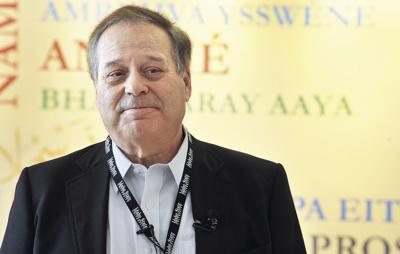
POCATELLO — After more than a decade at the helm of Idaho State University, President Arthur Vailas announced his retirement at the State Board of Education meeting on Wednesday at ISU's Pond Student Union.
After guiding the university through successful endeavors like the expansion of ISU’s health sciences offerings across the state, as well as weathering several controversies including multiple votes of no confidence and deteriorating relationships with various constituencies, Vailas told the board his last day as ISU's president would be June 17, 2018.
“I always say we fear of things that we don’t know,” Vailas told state board members during his announcement. “Education is the solution. It’s the solution to bringing understanding and it’s the solution of bringing comfort across the globe. The Earth, in a lot of ways, is flat. And basically, we have an opportunity and a lifetime to make a difference.”
Since arriving at ISU in July 2006, Vailas substantially increased university reserves — which were as low as $250,000 at one point — while simultaneously trying to reprioritize programs to enhance student offerings and administrative efficiency.
The search for Vailas' replacement will begin immediately, said Blake Youde, state board spokesman.
Richard Westerberg, the board member who will chair the search committee, had high praise for Vailas.
“Taken as a whole, Art Vailas’ tenure at ISU has been exceptional,” said Westerberg who resides in nearby Franklin County.
Throughout his tenure, Vailas made it his mission to broaden ISU’s health sciences footprint, which began with the ISU-Meridian campus opening in August 2009. Growing ISU's health sciences role was a well-earned victory considering the university’s financial position during the Great Recession, Vailas said.
Former ISU Associate Vice President of Health Sciences Linda Hatzenbuehler, who worked at ISU for more than 40 years, said the opening of the campus in Meridian marked one of Vailas' greater achievements.
“His procurement of the property in Meridian, Idaho has provided (ISU) health sciences the opportunity to expand dramatically,” Hatzenbuehler said. “We were able to expand our programs, and in many cases, replicate what we had in Eastern Idaho into Western Idaho, which provided expanded access to people who lived in that part of the state.”
In addition to introducing the ISU Bengal Pharmacy Program, which created rural pharmacies in locations like Challis, Arco and Council, Vailas capped his role as a health sciences leader by helping to bring the first medical school to Idaho.
ISU partnered with the private Idaho College of Osteopathic Medicine in 2016 to make the medical school happen. Construction of the school began in May at ISU's Meridian campus and the school anticipates accepting its first class of medical students in August 2018.
However, many critics of the partnership said Meridian wasn’t the best location and they would have liked to see the medical school built on or near ISU's main Pocatello campus.
Though Vailas’ retirement announcement is something he said he's been planning for a while, it comes at a time when controversy surrounds the university on multiple fronts.
A financial audit into what once was known as ISU’s Research and Innovation in Science and Engineering Complex resulted in a press conference last week, during which one of the university’s top officials alleged violations of state law had occurred at the facility. No formal charges have been filed by the authorities and ISU has not said what laws were broken or by whom.
What’s more, a group of Idaho State University football boosters and alumni, including well-known Pocatello car dealer Phil Meador, this week called for the removal of Vailas and ISU Athletic Director Jeff Tingey.
The boosters and alumni are withholding close to $80,000 from the school in fundraising money until the changes are made because of what they call the horrible state of ISU athletics.
“His retirement in my belief has nothing to do with what’s going on in the athletic program and other adverse articles,” Meador said about Vailas’ decision to announce his retirement on Wednesday. “This was on his agenda and I don’t think that negative press generated by fans and boosters has anything to do with his retirement. But we welcome his retirement and I hope that he gets credit for the things outside of athletics that he has accomplished.”
Vailas said during a Wednesday interview after his announcement that the demands by boosters and alumni that he and Tingey be removed played no role in his decision to retire.
“Nothing is more ridiculous,” Vailas said when asked if there was any connection. “It has nothing to do with time. It’s irrelevant.”
Vailas said it doesn’t matter what boosters and alumni think — nor does it matter what he thinks about the situation.
“This was a train already on its road,” Vailas said about his retirement.
Vailas said his positive relationship with ISU's students is his greatest accomplishment.
“My greatest feeling is I loved being around students,” Vailas said. “I really enjoyed the few opportunities I had to actually come to the (Pond Student) Union, eat with them, listen and work with all the student body leadership.”
Current members of his cabinet agreed with Vailas’ statement about his relationship with students, with Laura Woodworth-Ney, ISU's executive vice president and provost, lauding the president’s approachability.
“He’s been very committed to his staff and very supportive to ensure that his own staff has professional development opportunities and he also was very accessible and committed to students,” Woodworth-Ney said. “I don’t think that was the norm in higher education. He has been committed to making sure our student experience was good and improving.”
ISU Vice President for University Advancement Kent Tingey, the father of Jeff Tingey, echoed a similar sentiment.
“What I noticed about President Vailas from the moment he arrived on campus was that he is fearless, competitive, he loves the students and has an absolute drive to provide opportunity and benefits to the students of ISU,” Kent Tingey said. “In the president’s mind and heart, he has always had a vision for what he thought ISU could achieve."
Kent Tingey continued, "He had this ability that no matter what the distraction he keeps his eye on the prize and sought constantly to achieve that dream for the university, particularly as it related to student success. Every conversation ended with, ‘What is best for the students?’”
The flip side of the praise being thrown at Vailas following his Wednesday announcement is the stark reality of the controversies that seemed to plague his time at ISU.
The school's faculty and students both gave him votes of no confidence during the 2010-11 school year, followed by the state board signing off on a Vailas recommendation to disband the faculty senate — a move that severely damaged his relationship with many ISU professors.
So much community backlash followed ISU's plan to build Vailas a new presidential mansion that the entire plan was scrapped in 2014.
ISU's Middle Eastern students alleged they were victims of racism last year and the New York Times and other national media outlets covered the story.
The subsequent departure of most of those Middle Eastern students has left ISU with enrollment and funding declines.
The Journal attempted to interview several current ISU faculty members Wednesday about Vailas' announcement but none wanted to comment.
Former ISU political science professor David Adler summed up Vailas' time as ISU's president as being full of highs and lows.
"When Arthur came on board he brought great hope for change and fundraising possibilities with hopes of elevating ISU as a research institution," Adler said. "And he certainly perused that path, although his presidency after a few years fell into considerable controversy as he and the faculty sparred over the direction of the university with respect to the role of research and teaching. That marked the low-point in the history of his administration. I think he will be remembered as a person who pushed hard to put ISU on sound financial footing."

(0) comments
Welcome to the discussion.
Log In