

A magnitude 3.3 earthquake struck near Park City, Utah, on Monday morning, but officials with the University of Utah Seismograph Stations say they don’t believe the event has any connection to the ongoing earthquake swarm in Southeast Idaho.
Dr. Keith D. Koper, director of University of Utah Seismograph Stations, said the Utah earthquake was widely felt. There were reports from Salt Lake City and other locations in the Salt Lake Valley as well as northern Utah County. However, he wasn’t aware of any damage caused by the incident.
Although earthquakes are continuing in Southeast Idaho as well, Koper said the size and number of the quakes here, believed to be aftershocks, have actually decreased in recent days.
A magnitude 5.3 mainshock, dubbed the Sulphur Peak Earthquake, took place shortly before 6 p.m. on Sept. 2, according to university officials. The epicenter of the earthquake was 15 kilometers east of Soda Springs, near Sulphur Peak.
University officials say there have been nearly 2,000 aftershocks since that time.
Koper said it’s not really unusual to have that many aftershocks; however, he considers the swarm near Soda Springs to be above average.
While there has been some concern that the aftershocks could trigger a larger earthquake, Koper said the likelihood is low and is continuing to drop as the number and magnitude of the quakes diminish.
“It is decreasing with time,” he said.
Officials with the U.S. Geological Survey agree.
While they can’t predict the exact time or place of an earthquake, they say they can review information from past earthquake activity in similar tectonic environments as well as recent aftershocks to forecast what could happen in the days ahead.
“Similar to weather models, our models will also change with more data and information,” according to the USGS website. “The longer this sequence goes on, the more we learn about what it will do in the future.”
USGS officials have forecast three possible scenarios for this week. They say the most likely scenario — at a 90-95 percent chance — is that the sequence will continue to decay and there will be fewer quakes.
“Earthquakes above M3 may be felt by those in the area, and occasional spikes in activity may be accompanied by additional M4 or larger earthquakes, but with none larger than the M5.3 mainshock,” according to the USGS website.
Officials say a similar magnitude 5.3 mainshock or larger earthquake could also occur. But that situation, known as a doublet, is rare and they only give that a 5-10 percent chance of happening here.
The third scenario would be for a much larger quake, up to magnitude 7.0, to occur, but they only give that a 1 percent chance of happening.
“It is important to understand that this is a highly unlikely scenario, but we cannot ignore the possibility of this occurring,” according to the USGS website.
USGS officials remind people to “Drop, Cover and Hold On” in the event of an earthquake. Even those that feel small at the beginning can quickly build in shaking intensity, they say, so it’s best to always take precautions.
The Sulphur Peak Earthquake began with nine foreshocks, ranging in magnitude from 1.3 to 4.1. Those occurred within 34 minutes of the 5.3 mainshock that was felt by more than 1,800 people in Southeast Idaho, western Wyoming and northern Utah, university officials said.
There have been more than 1,900 aftershocks in recent weeks, they say, including 22 quakes of magnitude 4.0 or greater, and at least 136 ranging from 3.0 to 3.9.
University officials noted that the largest aftershock to date occurred on Sept. 10 and had a magnitude of 4.9.
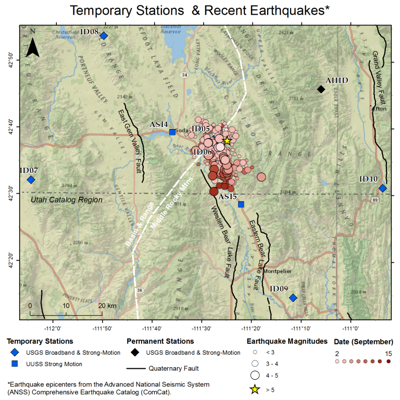
Working together, the university and USGS have deployed temporary seismic stations to the region and plan to continue monitoring the activity here.
“Eight seismic stations have been installed within 60 miles of the mainshock. Data from these seismic stations are being used to more accurately locate the earthquakes and detect smaller events,” according to the USGS website. “These data are helping researchers map the causative faults and will improve our understanding of earthquake hazard in the region.”

(0) comments
Welcome to the discussion.
Log In